Quarterly Review · Q3 2026 All issues
Construction costs in the CEMAC zone: a structural drag that investors and donors underestimate
Key messages
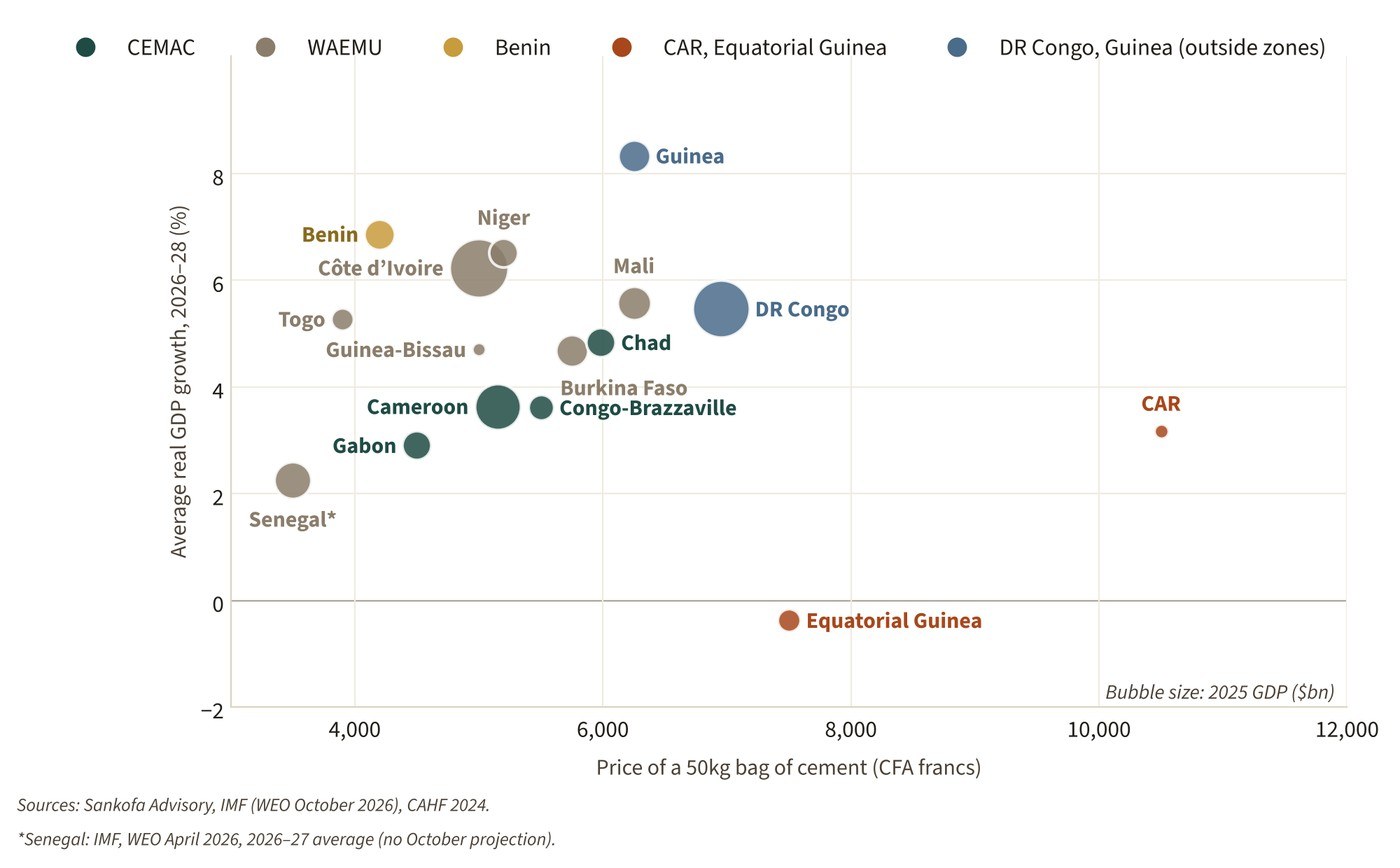
- Cement costs 2.3 times as much in Bangui as in Douala.
- 2026 widens the gap, and the aid that absorbed this extra cost is being withdrawn.
- Any successor to aid will be local capital, and only if investments yield at least about 10%, the going cost of that capital.
- Construction costs are the first bottleneck, and they are structural. A 50 kg bag of cement costs 10,750 CFA francs (€16.4) in Bangui, against 4,650 CFA francs (€7.1) in Douala and an average of 3,725 CFA francs in Dakar. The Central African Republic (CAR) produces no cement of its own and depends on a single corridor for more than 80% of its foreign trade.
- The market is split in two. On one side, large externally financed projects that are barely sensitive to prices (the Douala–Bangui corridor: $1.12bn). On the other, a mass market left behind: in Cameroon, 97% of housing is self-built (Centre for Affordable Housing Finance in Africa, CAHF, 2024), while public social housing costs about 175,000 CFA francs per square metre.
- The aid that masked this extra cost is being withdrawn. Official development assistance fell by 23.1% in 2025 (to $174.3bn) and the OECD expects a further fall of 5.8% in 2026. Markets are not stepping in: no CEMAC country is investment grade, and Cameroon borrowed at 10.125% in January 2026.
- 2026 adds to the bill. The Strait of Hormuz has been closed since early March (the war began on February 28th); Brent closed at about $98 on September 30th, against about $72–73 before the crisis. The dollar, the invoicing currency for imported materials, rose by 5.6% against the CFA franc between January 27th and September 30th.
- Three sources could step in, on one condition. The sources: institutional investors, the diaspora and mortgage lending. The condition: titled land, without which there is neither collateral nor lending. Local capital exists (more than $2.1trn managed by African institutional investors, according to the African Development Bank), but over 80% of it sits in government securities. To lure it away from government paper, a rental home would have to yield more than 10.1%, an imperfect yardstick, as that is the rate at which the Cameroonian state borrowed in dollars in January 2026.
Get the full Review
The summary is free to read. Sign-up for the full Review (charts and appendices) will open shortly.
Until then, ask for it by e‑mail and we will send it to you.
Request the Review by e‑mail